

Max Kaus
Berlin
1891 -
Berlin
1977
Max Kaus was born in Berlin on 11 March 1891. After serving a painter's apprenticeship, he attended the School for Crafts and the Applied and Decorative Arts in Berlin-Charlottenburg, while working as a decoration painter on the side. As a young man, Max Kaus first came into contact with Italian Renaissance art through the Kaiser-Friedrich Museum. Since he wanted to establish himself as a freelance painter, Kaus moved into his first studio in 1913.
A travel grant to Paris in spring 1914 enabled Kaus to visit the art metropolis; the outbreak of the first world war, however, forced him to break off his stay there and return home.
Kaus volunteered as a medical orderly in 1916. The artists he met while serving included Erich Heckel, Anton Kerschbaumer and Otto Herbig. Inspired by Heckel - his role model both as a man and an artist - Kaus did lithographs and woodcuts. After the war he supported himself by accepting commissions for decorative painting.
Max Kaus was really interested in the fine arts and it was not long before he began to be successful: he had his first one-man show at the Ferdinand Möller Gallery in 1919. After meeting Otto Mueller and Karl Schmidt-Rottluff at the "Free Secession" in 1920, Kaus became a member of the group, exhibiting work regularly at their shows. The following year Max Kaus joined both the "Berlin Secession" and the "Munich Expressionist Workshops".
By the last third of the 1920s his Expressionist phase was drawing to a close. In 1926 Kaus was appointed to teach landscape painting, drawing from the nude and drawing animals at the Master School for the Applied and Decorative Arts in Berlin.
In 1927 Kaus was awarded the Albrecht-Dürer Prize of the city of Nuremberg. Two years later he received the Villa Romana Prize.
During the 1930s Kaus worked mainly in landscape, drawing on travels within Germany as well as northern Italy and Austria as the inspiration for the many landscapes he did during those years. From 1935 Kaus taught figurative painting at the United State Schools in Berlin but was increasingly exposed to persecution by the National Socialists.
In 1937 his works were removed from museums and in 1938 Max Kaus was forced to give up teaching. After the second world war Kaus again held a teaching appointment at the Hochschule für bildende Künste in Berlin. From 1949 he was a full professor there and, from 1953, also deputy director. The artist's postwar work can be divided into four complexes: the North Sea and Rome pictures, the group of Venetian impressions that he embarked on in the early 1960s, and the portraits and still lifes of his last years.
Max Kaus - who belongs to the second generation of Expressionists - died in Berlin on 5 August 1977.
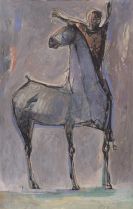
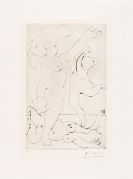

Would you like to sell a work by Max Kaus?
Infos for seller


Starting bid: 9,000 EUR